Markarian’s Chain
Description:
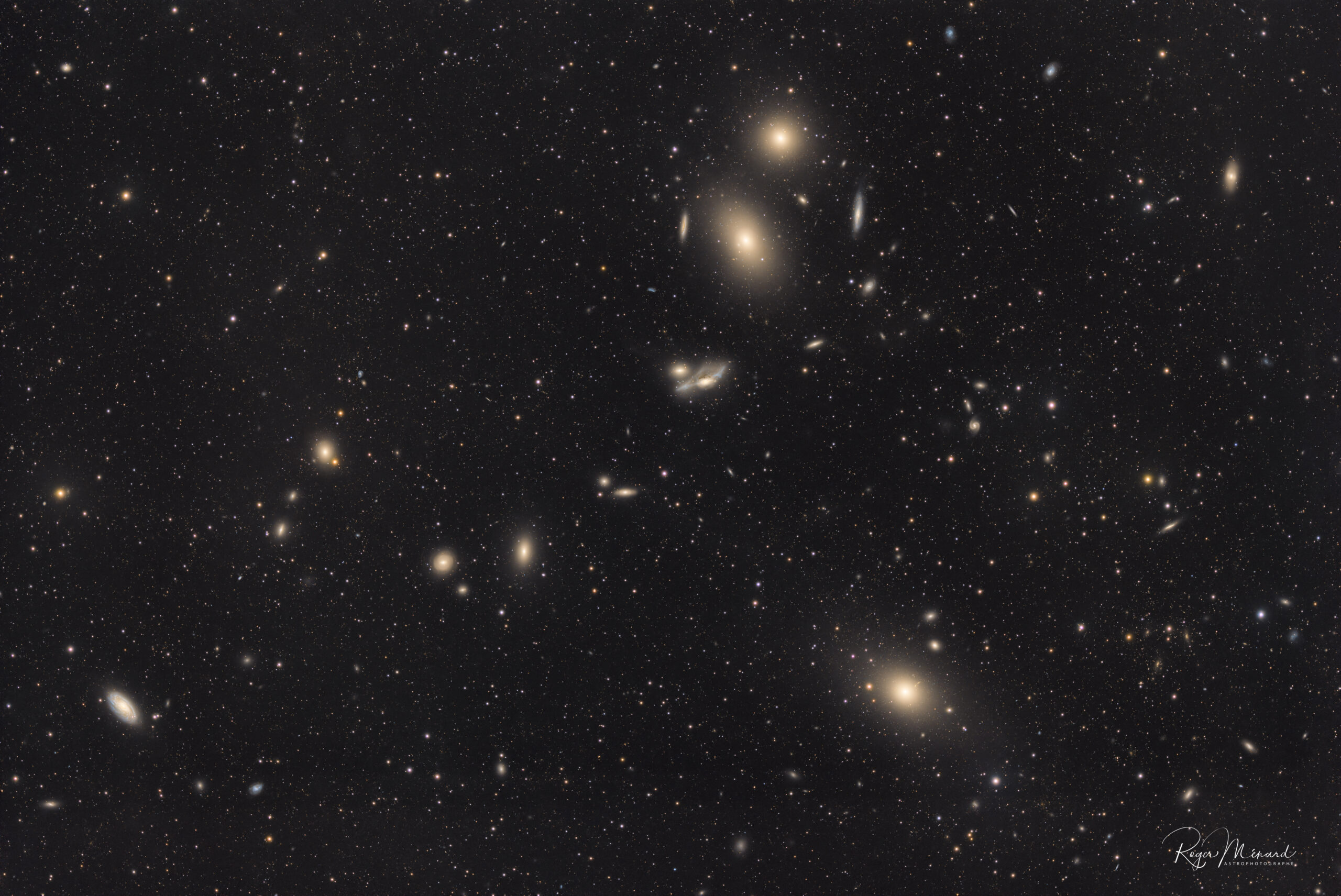
Markarian’s Chain is a group of galaxies spanning nearly 2 degrees and belonging to the much larger Virgo Cluster, located approximately 50 million light-years away.
It is named after the Armenian astronomer Benjamin Markarian, who first discovered, in the 1960s, that the galaxies in this group share a common motion.
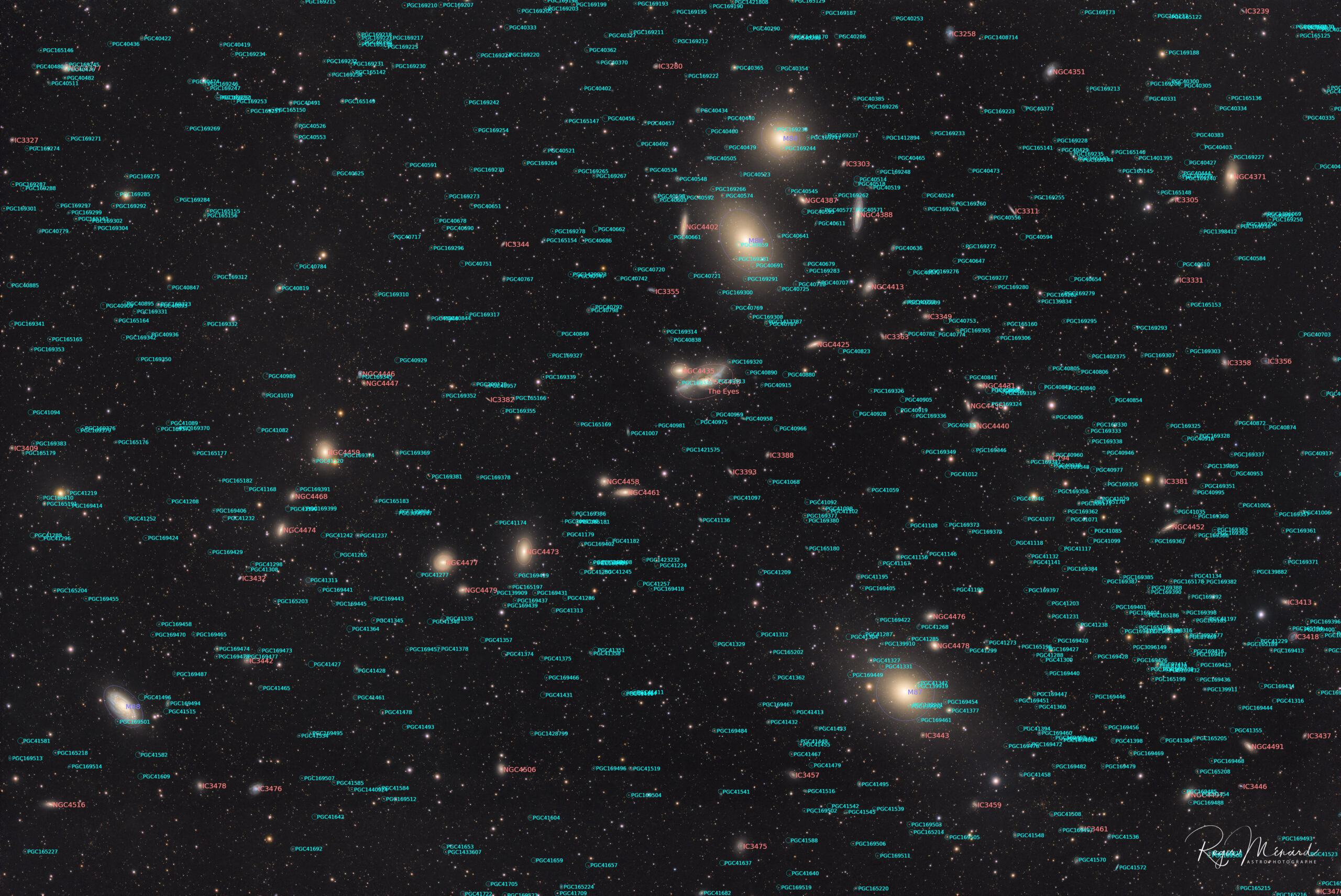
The chain comprises eight galaxies, including M84, M86, NGC 4477, NGC 4473, NGC 4461, NGC 4458, NGC 4438, and NGC 4435.
Other galaxies are also visible in this region but are not part of the “Chain.” This includes the supermassive galaxy M87, the dominant galaxy in the Virgo Cluster, visible in the lower right of this image.
An elliptical galaxy offering few characterized details (notably due to the absence of dust bands), M87 contains at its center a supermassive black hole which constitutes the main element of its active nucleus.
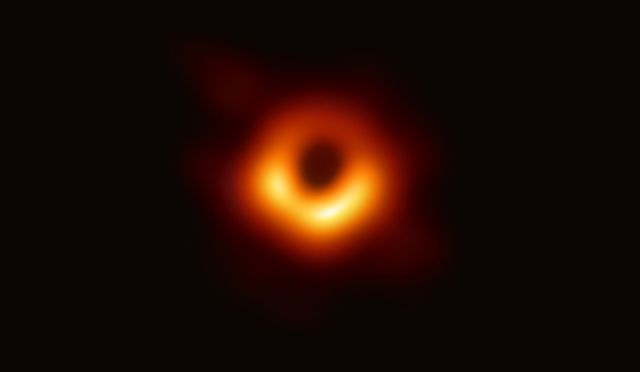
The black hole in M87 was the subject of a specific observation campaign, conducted over several years by more than 200 researchers. By using 8 radio telescopes distributed around the globe and combining their different signals, the Event Horizon Telescope collaboration was thus able to obtain, through interferometry, the first true photograph of a black hole!
Technical details:
Telescope: William Optics GT81 with a 0.8x focal reducer
Mount: iOptron CEM26EC
Camera: ZWO ASI 2600MC pro
Filter: none
Exposures: 134 x 5 minutes for a total of 11 hours
Identification:
The second photo, further down, allows us to identify the many other galaxies visible in this region of the Virgo galaxy cluster.